Spanish Rice with Three Little Pigs Chorizo and Prawns

Main courseServes 2

Cook the onion and pepper in 2 tbsp  of rapeseed oil in a large flat pan until softened. Add the Three Little Pigs chorizo and cook for a few minutes until the red oil is released. Stir in the rice until coated. Stir the saffron into the chicken stock. Add stock to the pan and stir well. Put on a lid and cook for 15 minutes until the rice is tender and the stock absorbed. Stir in the prawns until heated through completely, then squeeze over lemon and stir through the parsley.

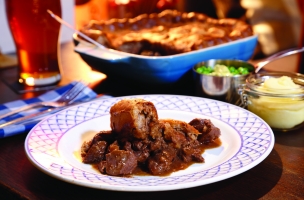
Lamb Suet Pudding served at The Farmer’s Cart Café

Main courseServes 4

 PREP TIME  1 hr * COOK TIME 2.5hrs Melt the butter with one tbsp. of oil in a large saucepan, over a low-medium heat. When the butter is foaming, add the shallots and garlic and cook for a few minutes until they begin to soften, but not colour. In a large bowl, mix tbsp. of flour with chopped rosemary, salt and pepper. Add the lamb and toss them thoroughly in the seasoned flour. Transfer the softened shallots and garlic to a large bowl and leave to one side. Add a little more oil to the pan and increase the heat. Add all of the lamb and cook until browned all over adding more oil if needed. Return all the shallots to the pan. Add the wine to the pan and let it bubble and reduce for a few minutes, scraping the base of the pan with a spatula to help release any caramelised bits. Add the stock and simmer for 5 minutes. If the sauce looks too thick, add some more stock. Taste the sauce and season with salt and pepper. When you are ready to cook the pudding, first generously butter a 1.2 litre/2 pint pudding basin. To make the pastry, mix the ingredients together thoroughly and season with salt and pepper. Gradually stir in water until you have a soft, slightly sticky dough (you’ll need about 225ml/8fl oz of water). Divide off about a quarter of the dough, to be used for the pastry lid. Dust your work surface with flour and roll out the larger piece of dough into a circle roughly 30cm/12in in diameter. Use this to line the pudding basin, leaving the excess pastry hanging over the edge. Roll out the small piece of dough large enough to form a lid for the basin. Spoon the cooled filling into the pastry-lined basin. Dampen the edges with water and add the pastry lid. Press the edges together to seal and trim away the excess pastry neatly. Place a piece of baking parchment over a sheet of foil and make a large pleat in the middle, folding both sheets together (this allows the pudding to expand as it cooks). Put the parchment and foil on top of the pudding, foil side up, and secure with string, looping the end of the string over the top of the pudding and tying it to form a handle that will enable you to lift the pudding in and out of the saucepan. Place the basin in a large pan, and pour in enough boiling water to come halfway up the side of the basin. Put a lid on the pan and bring to a simmer. Turn the heat low and let the pudding steam for 2-2½ hours. Top up the boiling water during this time if necessary so the pan doesn’t boil dry. Remove the pudding from the pan, take off the foil and parchment and leave to rest for five minutes. Then use a small, sharp knife to release the sides of the pudding from the basin. Put a large plate over the pudding and invert it, so the pudding comes out on to the plate. We serve with cury kale and mash potatoes (all grown on our farm).  

Butt’s Bloomer from Farnley Market

Side dishServes 6

To make the Sponge Disperse the pinch yeast in tepid milk (around 20°C) In a bowl mix the milk and yeast with the flour until the dough comes together. Cover the bowl with cling film & ferment in a warm place (18 to 20°C) for 16 to 20 hours Final Mix Soften the butter until very soft but not melted Warm the milk until tepid then crumble the yeast into the milk & mix until dissolved – Place the milk/yeast mixture in a large mixing bowl Add flour and the pre prepared sponge to the mixing bowl Bring ingredients together & knead for around 3 minutes, then add the salt. Knead for a further 5 minutes until gluten is well developed Add butter & knead until incorporated then add the honey & knead again until incorporated. Ferment  the mixture in a warm place (around 24°C) for 2 hours. Fold the dough twqice throughout this period, leaving at least a 45 minute interval between each fold. Once fermented divide  the dough into 2x 500 gram pieces and shape each one into your desired shape

  • If you are baking a tin loaf, oil the tin lightly first before placing your dough in it
  • If you would prefer to make a boule (round) or batard (oblong) loaf, dust your banneton (proving basket) prior to placing your dough in it
Finally prove for a further 45 minutes or until ready in a warm place (24° C), ensuring your dough is covered to prevent skinning over. When proved, brush an egg wash with a mixture of 1 egg to 2 egg yolks & a pinch of salt over the dough. Slash the surface of the dough & bake on a baking tray at 230°C for 30 minutes or until a rich golden colour is achieved Turn out of tin (if necessary) & cool on wire racks.

Simple Rhubarb Jam

Jams & ChutneysServes 4 jars

1.Tip the rhubarb into a large bowl or pan and add the sugar, lemon zest and juice, and chopped ginger. Finely grate the fresh ginger over the rhubarb. Stir, cover, and leave for a few hours, stirring occasionally.

  1. Put a couple of saucers or small plates in your freezer to chill. Pour the rhubarb  mix into a large pan and stir over a  medium heat until all the sugar has  dissolved, then bring the mix up  to a boil.
  1. Cook at a high temperature until the rhubarb is tender and the jam has reached setting point, this should take about 10-15 minutes.
  1. To test the jam for its setting point, drop ½ tsp of the jam ono one of the chilled saucers, and leave for 30 seconds. Gently push with your finger – If the jam wrinkles, it is ready, if not, continue to cook for a couple more minutes and then test again.
  1. When the jam is ready, remove from the heat and leave for 2-3 minutes to cool slightly. Pour into sterilised jars and seal immediately.
 

Yorkshire Brack

Cakes & BakingServes 8

Mix together the dried fruit and sugar and soak in the hot tea. Cover and leave overnight so the fruit becomes plump. Add the egg to the mixture and beat well. Stir in the flour. Line a ½ kg/1lb loaf tin. Put the mixture into the tin and bake in a preheated oven 160 C, 325 F, Mark 3 for about 1½ to 1¾ hours.

Cauliflower Cheese with Bacon and Mushrooms

Side dishServes 4

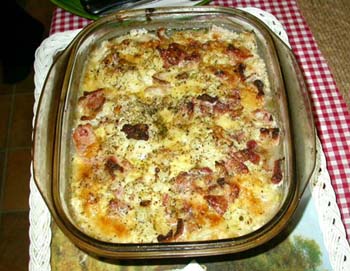
Boil a pan of water and add the cauliflower florets.  Cook for about 10 minutes or until tender and then drain. Fry the bacon lardons until coloured, remove from the pan and set aside but leave the fat in the pan.  Add the mushrooms and fry for 2 -3 minutes then set aside. Melt the butter in a saucepan and add the flour to make a roux.  Stir in the mustard powder, grated cheese and double cream.  The mixture should be thick and creamy once the cheese has melted.  Season to taste, then add the bacon and mushrooms. Preheat the oven to 180°C/350°F/Gas 4.  Place the cauliflower in an ovenproof casserole dish and pour over the sauce.  Sprinkle a pinch of freshly ground nutmeg over the top. Mix the breadcrumbs with the parmesan/monchego cheese and sprinkle over the mixture.  Cook for 15 minutes or until the topping is golden-brown and bubbling. Spoon the cauliflower cheese onto plates and serve with a crisp salad and crusty bread.

Prashad Bataka Bhajia – Potato Fritters with Coriander and Pepper Crunch

StarterServes 4

Crush the chillies and garlic together with a pinch of salt with a pestle and mortar (or in a blender) to make a fine masala paste. Put the batter ingredients and the masala paste in a medium bowl and gently mix, working the spices through it, to form a relatively runny batter. Cut the potatoes in 5mm-thick slices. Mix the coriander seeds and pepper in a small bowl. Heat the frying oil – about 15cm deep – in a large pan over a high heat (or in a deep fat fryer, if you have one) and when you think it is hot enough, test the temperature by sprinkling a few drops of batter in the oil. When it is up to temperature, the drops will quickly spring back up to float on the surface. Reduce the heat to medium. Put four potato slices in the batter and work them around to make sure they are fully coated. Lift one slice out of the batter by its edge, hold over the bowl for a moment to allow any excess batter to drip off, then turn to hold horizontally. Sprinkle the top surface with seed-pepper mix and carefully place in the oil sprinkled-side uppermost. Repeat with the other three battered slices. Some batter droplets may run off the potato slices – use a tea strainer or small sieve to remove them so that they do not burn. After three minutes turn the slices over with a slotted spoon or strainer to cook the other side. Cook for a further 4-5 minutes until the batter is a crispy golden brown and the seeds are dark brown. Remove from the oil and leave to rest on absorbent kitchen towels while you batter and fry the remaining potato slices in batches of four at a time.